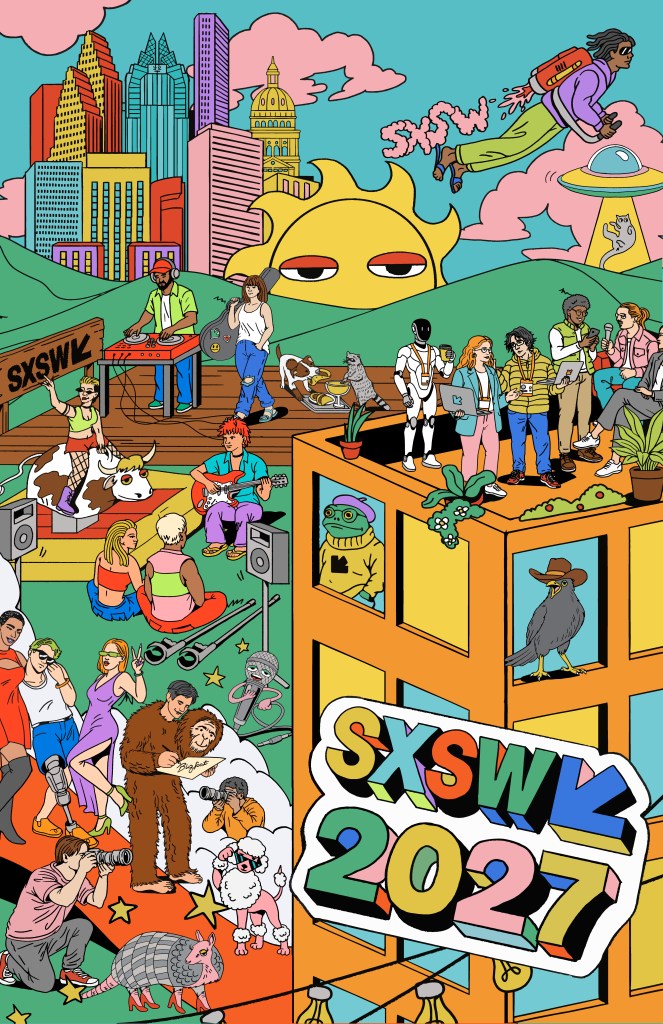
Fear. Humor. In-your-face color. These are just a few of the defining characteristics of Chilean artist María Jesús Contreras’s work. You might recognize her bold illustrations from The New York Times‘ Saturday morning paper, The Washington Post, Penguin Random House, Texas Monthly, The New Yorker, and Gucci, to name a few.
Every year, we commission an artist to try and capture the essence of SXSW and the city we all know and love. Contreras’s work is known for an almost Where’s Waldo-ness in her pieces. If you look a little closer, you can spot familiar faces, local landmarks, and everything in between tucked into every corner. That’s the exact spirit of SXSW 2027: thousands of small communities packed into one week, where there’s something and someone for everyone to discover.
For SXSW 2027, we’re focusing on exploring humanism and community, two things often lost in the whirlwind landscape where AI has become the go-to for the simplest tasks. We recently sat down with Contreras to discuss her artistic process, why Tears for Fears is the perfect motivational music, and how her gaucho childhood in Patagonia’s cowboy country stoked her inspiration for capturing Austin.


SXSW: What do you hope attendees take away from your work?
María Jesús Contreras: I’m providing probably one of the most eclectic versions of Austin that exists, but maybe people will think it’s funny and that’s enough for me, you know? If it makes you laugh, or it makes you feel weird; if it gives you some emotion, then my job is done. I want people to think, “What is going on with that thing in that character’s hand?”
Where exactly did you get your inspiration?
I’m from Southern Chile in Patagonia, so we’re cowboys… gauchos. I understand the vibe, but it’s completely different there because it’s much colder weather, which is tough. Even when you feel like a cowboy with boots, or a lasso, that’s something I can understand. But I also realize that Texas— well, Austin specifically, is such a metropolitan area where you have these different kinds of influences happening at the same time, which is very unique.

How would you describe the color palette?
María Jesús Contreras: I used a very saturated color palette with five colors for everything. I knew I had to create different colors for each category: Music, for example, was green. I had to relate everything to color. So I was thinking about music, which is often outside because people are enjoying it there, so I was basing the color palette on each type of environment where people would go to experience that.

Your work tends to mix fear and humor. Where does it show up here?
My main work is with the press each week, and I always try not to portray people’s faces too much, because for me, it’s very expressive. In this project, I tried to keep a muted face so you don’t know if they’re happy or not. When I was a kid, like all kids, I had this tendency of seeing faces in every object, you know? Like when you see a piece of wood, it’s like a creepy thing going on there. So when I was trying to do the hat for example, I knew this is the place where the mouth goes.
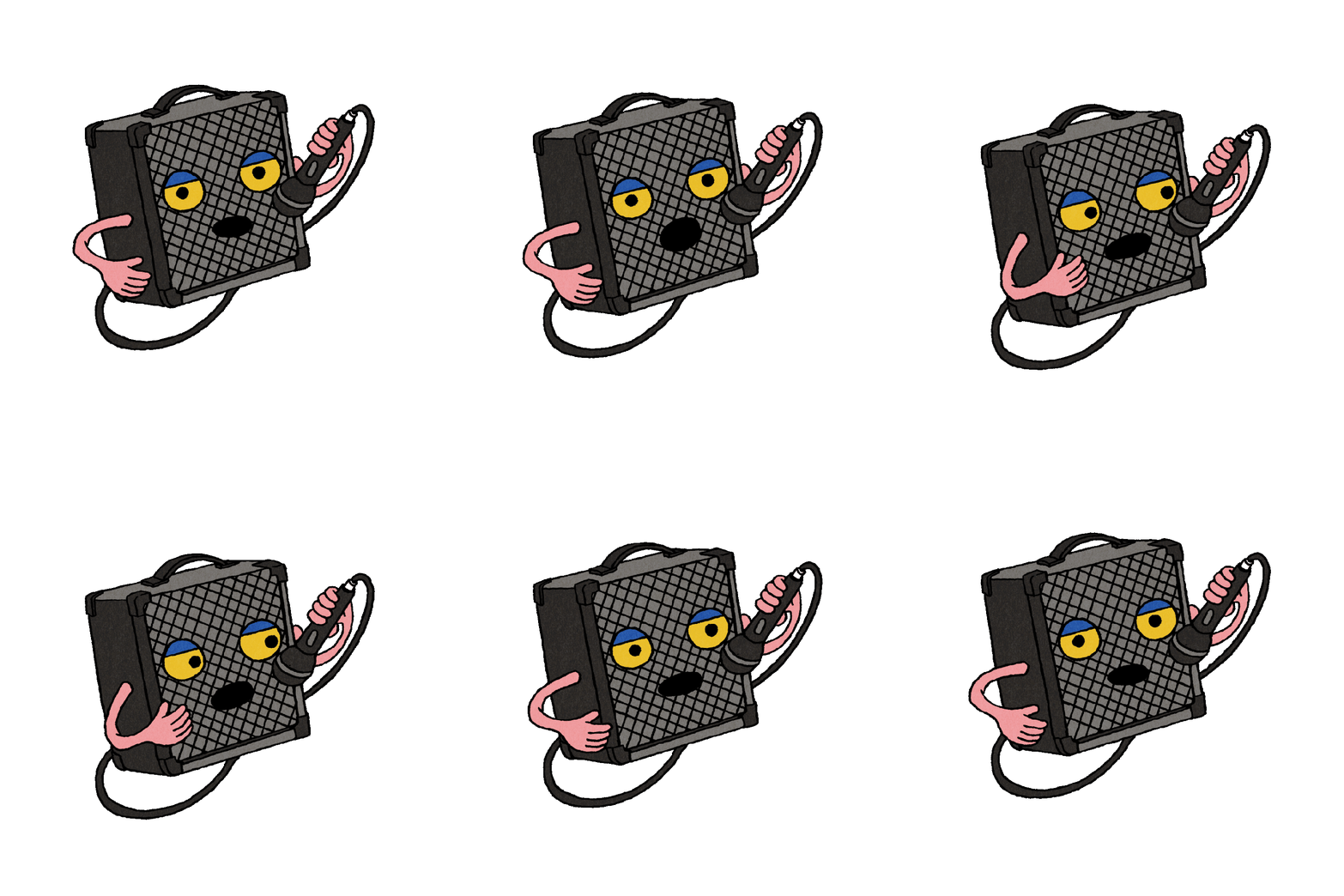
I love how these characters like the speaker, the longhorn, and the popcorn all have a human-like element, but they still lack expression.
Exactly! It’s very creepy to me, almost like I don’t know how to feel when I look at this, but it’s cool… that it’s a little bit upsetting, like a puppet. I don’t know if you know the puppet show “Don’t Hug me, I’m scared,” but it’s that kind of thing. Is this character happy? Is this character weird? So I prefer to go with a muted face.


If this project had a soundtrack playing in the background, what would it be?
I listen to a lot of Tears for Fears on vinyl.
What are your feelings as an artist towards the rise of AI in artistic spaces?
You’ve got to toughen up when you’re an artist. Maybe three years ago, this work would take four months to make it happen. People are losing perspective on how long it really takes to do a drawing. Nowadays, people probably expect you to do everything through a machine and with artificial intelligence. That’s why I also think as artists, we should move more to analog. I’m trying to do much more animation and analog stuff so people can actually see and say: “Hey look! There is a human behind the project.”
Thanks so much for speaking with us.
You can find María Jesús Contreras on Instagram and see more of her incredible work on her website.
A special thanks to Overstory for making this collaboration possible.